
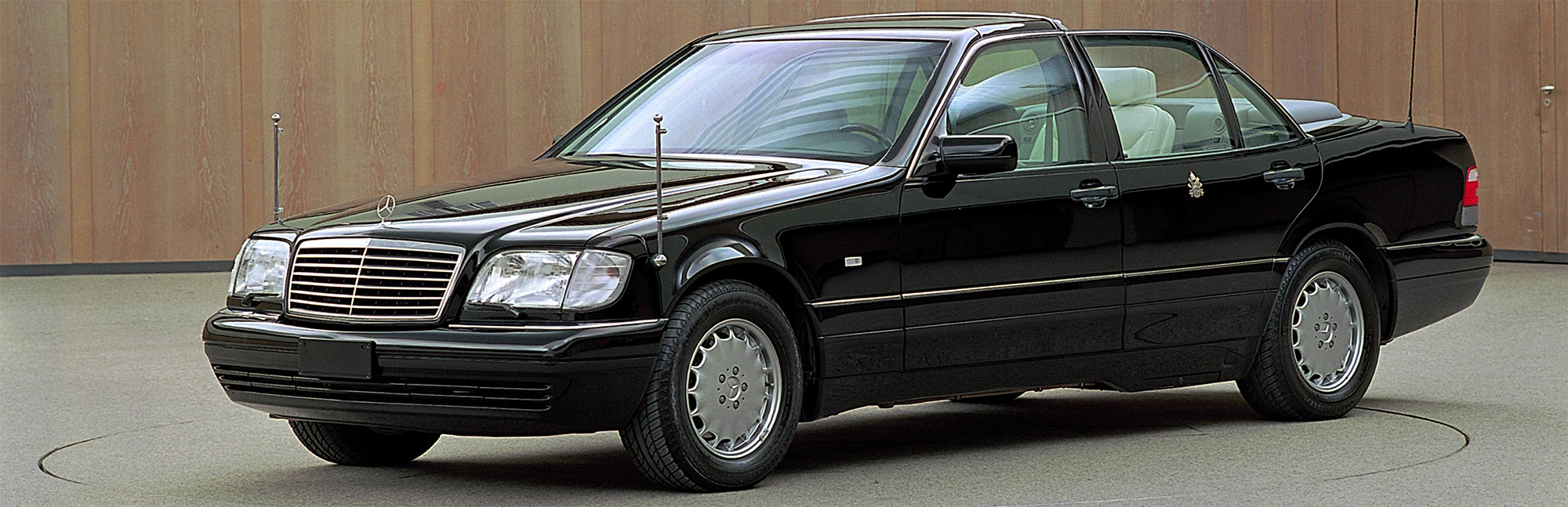
140 On Tour
The Multifaceted W140 a Practical Tourer
By Paul Lobanov-Rostovsky & Paul Mason
Both Paul’s decided in late spring that it was time for our W 140’s to have a good run out and to the Continent as a group activity, with a view to getting to see some well-known Car Museums, as well as to meet with Mercedes-Benz personnel in Stuttgart to meet face to face and give them first-hand information as to the growing problems of sourcing Spare Parts either from abroad or here in the U.K. in the hope that a person to person contact would yield constructive suggestions on sources within Germany we could expand and start using.
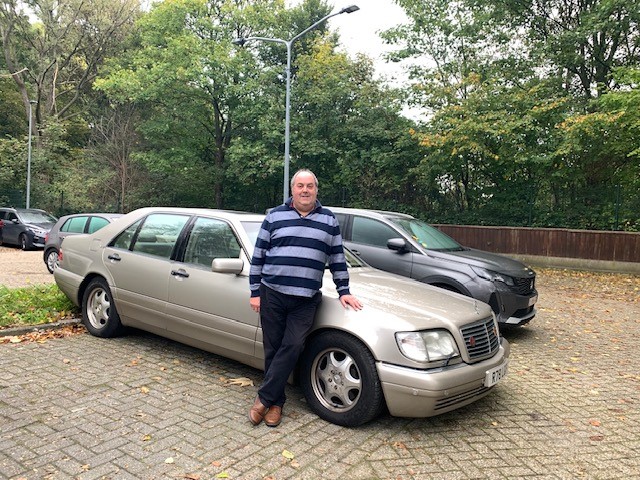
We invited Members from all of the various Groups in the Club via the Forum, What’s App and Signal Groups to bolster the numbers. In the end it was just us two that went. Now to recount our adventures with Paul L-R in an S 320 1996 and Paul Mason in an S600L 1998
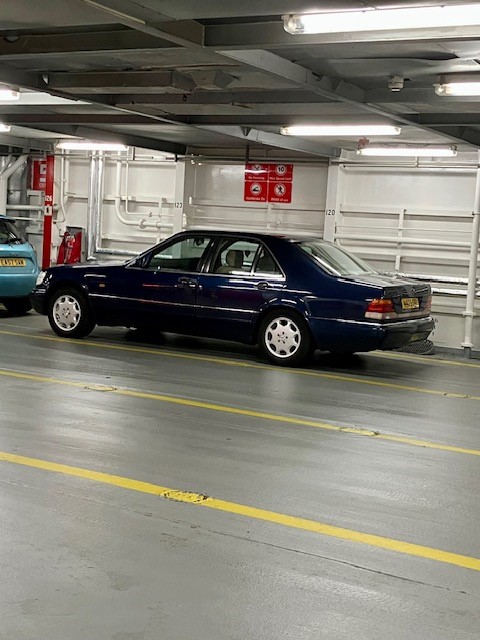
Day 1 (Saturday): Dover-Dunkerque-The Hague. We met at a Petrol Station a short distance from the Ferry Terminal and having made sure that our cars were as clean as possible made our way to the Ferry Terminal. The Ferry departed on time (14:00 hrs) and having enjoyed the delights of the sea and DFDS’s offerings in the canteen arrived at Dunkerque promptly 2 hours later. The coast Road up to Zeebrugge was relatively fast and without too high a volume of traffic thus it was a shock when hitting Antwerp to find lane upon lane of traffic merging from non- motorway sources all trying to transit South to North. It was reminiscent of being a European coming out of Los Angeles Airport for the first time to find 11 lanes of traffic right there and you in the midst of it. This took nearly 2 hours just for this section alone and surprisingly we did not get separated. Once clear, we proceeded Northwest of Rotterdam to the quieter region of the Hague and arrived at our pre-booked Hotel. Arrival at 9 pm meant that dinner was not available and thus it became beer o’clock. Given that we were due to go out early this worked well. A relatively early night was had after review of some of the manoeuvres we had seen around Antwerp which had left us both a bit staggered realising that in some ways the way of driving “think Wacky Races” in England was sedate in comparison to where we were. Dunkirk-The Hague is a distance of about 200 miles and my S320 averaged from 26.5 mpg Brighton to Dover & Dunkirk - The Hague just under 25 mpg .Paul Mason’s car Averaged 26.72 MPG from Northallerton to Dover & 26.5 mpg Dunkirk to The Hague….
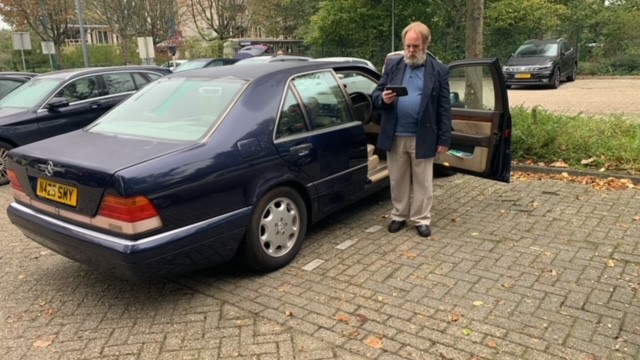
This is when the Sat Nav that Paul Mason had lent came out of its box and resisted being updated, refusing to even start the process having wiped itself of previous content.
Much persistence, fretting and an overnight internet connection finally updated it ready for action.
Day 2 (Sunday): The Hague - Erkelenz. We left the hotel for a 9:30 a.m. start at the LOUWMAN Museum in the Hague. This one is not very well publicised and thanks to Paul Mason we found this as an alternative to the OCKHUISEN collection which we had intended to visit. The OCKHUISEN collection people did not respond to emails, pick up the phone or show any signs of life even with a friend of ours on the continent trying to make contact. The LOUWMAN Museum was formerly known as the National Automobile Museum and still today it is one of the oldest private collections of motor cars, compiled by two generations of the Louwman family. P.W. Louwman the founder born 1902 died 1969. The museum dates back to 1934 and now comprises over two hundred and fifty antique and classic motor cars with nothing newer than the late 1970’s. Experts regard the collection as one of the most beautiful in the World. The museum exudes passion. Each car has its own story to tell, its own contribution to history. The motor car is a mirror of culture. The collection is housed in a purpose-built museum in The Hague, the city where P.W. Louwman established his Dodge and Chrysler import company. The building, designed by American architect Michael Graves, blends in sympathetically with its historic surroundings. The landscape gardens surrounding are designed by Lodewijk Baljon and complement the architecture of the building. It is well worthy of a visit as the layout of the Museum is well organised spacious and starts at the beginning of Motor History through to the modern day.
For Mercedes-Benz Owners and followers what makes this Museum special is that it houses the famous “Butchers Car” – This is a 1936 500K Spezial Roadster and only 25 models of this luxury version were ever made. The car was delivered to a London Shipping Insurer in 1936. In the 1950’s it was acquired by a Butcher from Walsall who used it regularly but in 1956 he stored it is his barn. It was rediscovered 30 years later and then acquired by a Swedish Owner who had it completely restored to original in Germany. The Car won first Prize at Pebble Beach in 1994 and in 2006 won the Briggs Cunningham Trophy (also at Pebble Beach).
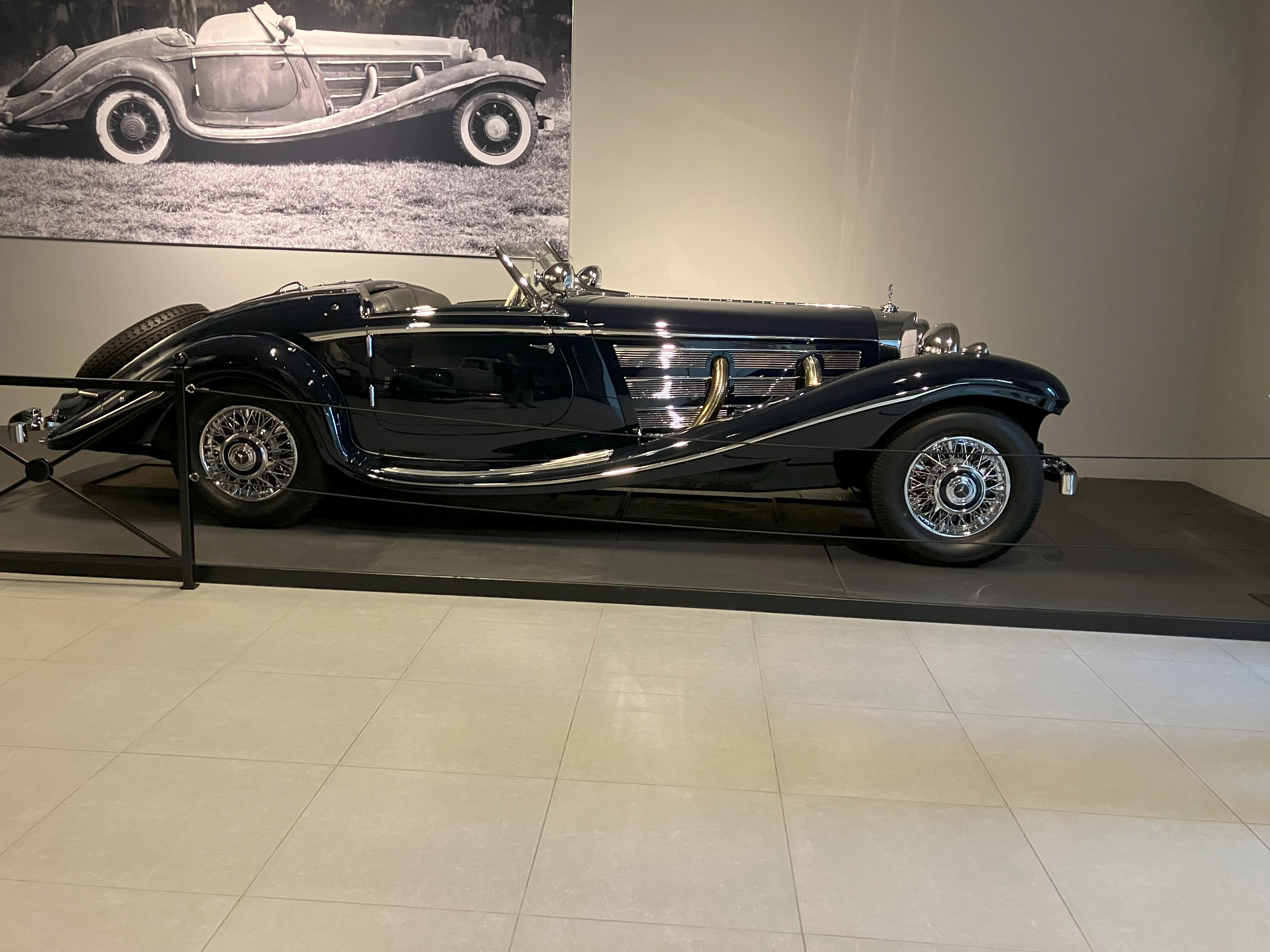
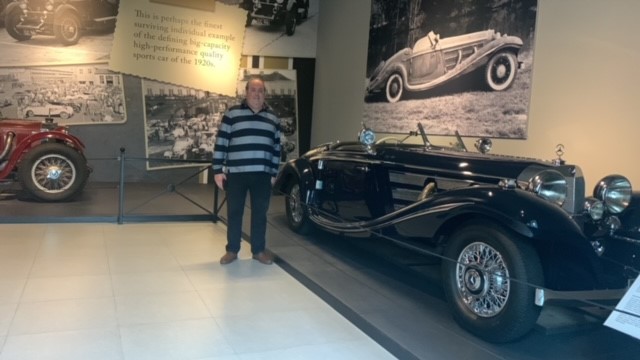
Having been close up, it exudes elegance, quality and style on a level not seen since the 1930’s and simply has desirability surrounding it. It is breath taking, and the restoration work of a quality that needs to be seen to be believed.
In the collection there is something for everyone from each decade with Cars from 1886 – Baker Electric Vehicles from the early 1900’s – all makes not just Mercedes-Benz. Sir Winston Churchill’s Humber and General Montgomery’s motorcycle, American Cars through the decades Elvis Presley’s customized Cadillac, The Lincoln used the film the Godfather and one of the 3 original Aston Martin DB 6’s altered at the factory for the James Bond Films, even Formula 1 Racing cars and notably also Kaiser Wilhelm II Mercedes-Benz from 1933, a 1935 Duesenberg SJ Lagrande with other Duesenberg’s making their presence felt.
I can only recommend to readers to take time out to go to this Museum as it is easily accessible well laid out spacious with eateries on sight and engaging to the extent that you need a good 5-6 hours to get around it, noting the historical significance of what you are seeing.
Early afternoon, having really enjoyed and photographed what we had seen (Mr Mason’s phone permanently clicking with photos being taken), we set off from the Hague to Erkelenz, equidistant 50 km west of Dusseldorf or Cologne.
We had arranged to meet and have dinner with a friend of the Club, well known to the North-East What’s App group, who had kindly tried to help us get in to see the OCKHUISEN collection. We dined in good company at a very small and empty Italian Restaurant in the centre of the town enjoying the delights of off the menu cooked at short notice Italian food, needless to say washed down with some very good German beer, having been collected and returned to our respective hotels by our friend in his beautiful 1960’s 220 Fintail running on LPG.
Paul Mason had secured a room in a hotel in town and PL-R found himself out in the countryside in a converted Farm about 7 miles away. The Hague to Erkelenz about 160 miles my S 320 mpg improved to 26.5 mpg – Paul Mason averaged 26.72 mpg
We fuelled the cars with 102 Octane fuel from Aral (co-incidentally owned by BP). Instantly the upgrade in octane was noticeable in the smoother running of the engine even from 99 Octane.
Note here that the Motorways in Holland have a maximum speed limit of 100 kph (60mph) unlike those of Germany where the speed limit is 130kph (80 mph)
Day 3 (Monday) Erkelenz- Speyer. A departure at 9:30 with the Sat Nav programmed. Distance about 200 miles on Motorways arriving 14:30. PL-R struggled with his “Nemesis” the Sat Nav and managed to miss the appropriate turn off to Speyer, continuing to the next exit and coming back via small towns delaying arrival by at least 30 minutes. Our hotel was a few minutes’ walk from the main shopping street of the town, and given it was too late to go round a museum we settled for a couple of beers in the warm weather contemplating the options for dinner, which with limited options turned out to be the German interpretation of an American diner, with which we were note particularly enamoured.
Day 4 (Tuesday) Visit to Deutches Technik Museum Speyer. The Technik Museum is split over 2 sites, and the one visited today is a very short distance from the town centre of Speyer, whilst tomorrow we go to The Technik Museum at Sinsheim about 25 km away. For those of you who have already visited I shall endeavour to summarise in succinct form, so that those readers who have not visited get a good feel of what is available and are incentivised to make a trip. The Museum opens at 9 a.m. and being a Technik Museum is not limited to Cars but includes Aircraft, Trucks, Motorcycles, Buses, Dragsters, Racing and Rallye Cars, the BURAN (the Russian equivalent to Space Shuttle), Rolls-Royce RB 211 Engine, Fighter jets such as MIG aircraft from varying eras, and notably a Boeing 747 Jet on a stand about 150 feet off the ground. Visitors can climb up a set of stairs and enter the passenger space and view the cockpit. The Museum covers the period from about 1907 to present day and is well laid out with plenty of room for visitors, spread over 2 Halls. There are plenty of aircraft to see outside as well as simple engines showing the evolution of the more complicated mechanisms. There is a well-balanced mix of Mercedes-Benz and Maybach’s from each and every decade. In addition to this there are many manufacturers displaying as well Access in and out of the building is easy, likewise the Car Park. About 5-6 hours is needed to absorb whatever content is of interest to you. “There is something for everyone” is a well-worn phrase but very applicable here.
A visit very well worth taking, showing the development of engineering capability and how far we have come over the years. I would encourage readers to the make the effort to go and visit.
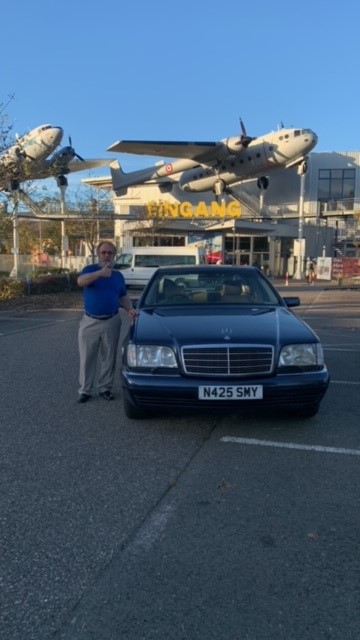
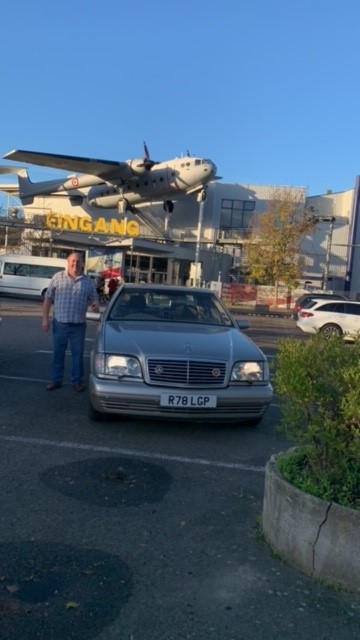
Returning to the hotel that evening we sent an e-mail to the Classics and Classic Spare Parts Division (following up on the emails sent prior to our departure), advising them that we would be in Stuttgart in 2 days’ time We invited them for either have a beer or a dinner with us in convivial surroundings to familiarize ourselves with the MB ethic towards Classics and seek some assistance with the issue of sourcing Spare Parts effectively. Having had an interesting dinner the night before we resorted to the safety of an Italian Restaurant (with the assistance of Google Maps) to find that there wasn’t a single Italian on the staff. Notwithstanding, the food was enjoyable and welcome after many hours of walking around.
Day 5 (Wednesday) Visit to Deutches Technik Museum at Sinsheim. Another early start with 25 km drive to the location. An impressive sight, upon arrival of one of the original Concord’s alongside a Tupelov 144, the Russian equivalent over the roof on the Museum Hall. An impressive range of Dragsters, Supercharged Cars, Sports Cars with Jet Fighters, Propellor Fighters, Tractors, Tanks, various utility vehicles, Formula 1 Racing Cars, Rally Cars, Pace Cars, and, a beautiful collection of Bugatti’s of all eras greet you, ensuring that you are going to spend a lot of time looking at it all.
There is a fantastic range of Mercedes-Benz cars from all era’s including those of historical significance including the limousine and the convertible used by the Fuhrer and the Reichs Fuhrer both of which are bullet proofed. There is a similar grey coloured 6-wheel drive version (Mercedes G4) of the same used in the field. There is a wider selection of Maybachs through the decades here than there is at Speyer. These are notable when going round. There is one Maybach that had its back chopped off by the owner, who was in need of earning money during the tough times and built a platform, placed a chainsaw mechanism in order to chop wood. The car remains unaltered still to this day. The Museum houses one of the rarest cars still today, a Horch 853A built 1938. Horch was a specialist division of Auto Union which in due course became Audi as we know it today. August Horch, whose name is given to the car, had been previously the production manager for Karl Benz, and formed Horch back in 1904. The merger with auto Union had already occurred in 1932, thus the 1938 built car came under the Auto Union banner. There are some superb examples of all of the forms of Adenaeur (W186/ 188), W100 Grosser SWB and spectacular Mercedes models though the decades to attract the enthusiast. Outside again here a collection of Commercial and fighter aircraft suspended over the Halls. This collection is a must see!
Late afternoon; time to drive to Boblingen, and the well-known V8 Hotel which 25 km Southwest of Stuttgart centre. The V8 Hotel is a car enthusiast themed hotel in a complex known as Motorworld.
Speyer to Boblingen about 135 km distance. My S320 averaged 25.5 mpg. Paul Mason’s Car averaged 31.05 mpg
V 8 Hotel, which was suggested to us by Nicky Porter, is a once in a lifetime experience. To have a bed with the front end of a range of different cars (Mercedes, Jeep, VW, Lancia, Citroen) at the foot, which is very novel and highly original. What is not evident upon arrival is what is surrounding you in Motorworld itself.
In the reception hall at the hotel, you are greeted by a Brand new Metallic Green Bentley Continental GT Speed on display with a price tag of 335,000 Euros! The mood is set!
Day 5 (Thursday) Motorworld at Boblingen. Being rather weary from having walked about 8 km per day in each of the preceding Museums an executive decision was taken to spend time going around Motorworld. It was a welcome change and revealed many interesting things. Adjoining the Hotel was a car Showroom that sold a fascinating range of older totally restored to original spec Mercedes, all either price upon request or starting at about 250,000 Euros.
Examples - 1970 280 SE coupe, 1979 280Se Cabriolet, 1956 220 Cabriolet Adenauer, 1927 320 Cabriolet B and a retrieved from scrapyard 190 SL. We figured would be initially bought by a customer and then an arrangement made as to the level of restoration to be undertaken.
This showroom has a fully restored copy of the world famous “Red Pig” very well known in Racing circles – a Mercedes-Benz 300 SEL 6.8 AMG with full race spec badging head lights wide wheels and the Number 35 sticker. It is now owned by a South Korean it has travelled less than 800 km since its restoration.
Surrounding the Hotel were a series of Workshops and Sales Departments for the likes of Bentley, Ferrari, Lamborghini, as well as 2nd hand quality cars. Workshops were manned and fully operational. Interesting to note within all of this was Car Storage on 2 tiers with clear glass showing the vehicles.
The whole site is on what used to be the airport for Boblingen - Sindelfingen region.
Day 6 (Friday) Mercedes-Benz Museum Stuttgart. Rather than driving we decided to use the local rail network to get to and from the Museum with a transit time of 35 minutes each way. The Museum complex has a separate building for customers to collect their brand-new cars. The Museum Building itself is high modernistic in design and consists of seven floors. There is a spiral walkway on the outside of the display at each level. Starting from top you work your way down. The content was disappointing comparative to that seen at previous Museums and does offer some early 20th Century, Commercial Vehicles, Buses, Touring Cars of the 1930’s, 1950’s Saloons and Sports cars as well as a Mercedes-AMT GT concept 0f 2017 which has a very appealing body shape.
Of note is the Mercedes-Benz Racing Car Transporter, (The Renn Transport), which is a one of a kind built by the MB Testing Department and used during the racing season of 1954 – 1955. Without any race cars to transport, the transporter was left in a corner of the Mercedes-Benz workshop and later moved to a warehouse. As the valuable space was needed for new projects, the large transporter was finally moved outside to a remote corner of the factory test track. Here, the transporter was forgotten before the rusty parts were finally cleaned up in 1967.
Day 7 (Saturday) Boblingen to Dunkerque via Luxemburg: A 761 km drive to be done in about 8 hours! Well, this is where PL-R’s Nemesis the ‘SatNav’ made its play for power. Getting thoroughly confused it kept me driving around in circles in the back streets of Stuttgart for nearly an hour whilst Mr Mason was sitting in the first rest stop on the A 8 wondering what the devil was going on. A few frantic phone calls and some choice language to the Sat Nav and eventually having turned it off and re-booting, the right route was embarked upon, but unlike before more roadworks than normal. Luxemburg was reached as an agreed refuelling point, again with what was supposed to be 102 Octane fuel being available. Having managed to keep together thus far the separation on the routes started. It seems Mr Mason decided that the Sat Nav was not to be relied upon whilst muggins thought best to stick with it. As a consequence, Mr Mason went off grid, so to speak, whilst PL-R was being goaded on to RN Roads wondering where he would wind up and if he would ever see Dunkerque. Eventually, re-joining the highway put the pressure on to make up miles and time. With much luck and reduced congestion than at the start of the drive, PL-R managed to get to the ferry Terminal with 15 minutes to spare before the intended departure of the Ferry at 16:00 Hours. Mr. Mason, despite having been the lead driver and route master, found to his disdain that the Saturday afternoon mob were out for a jaunt causing traffic Jams and accidents ensuring that this ETA at the Ferry terminal was to be delayed until at least 16:45 hours. In fact, one of the accidents caused a delay of nearly an hour waiting in queues.
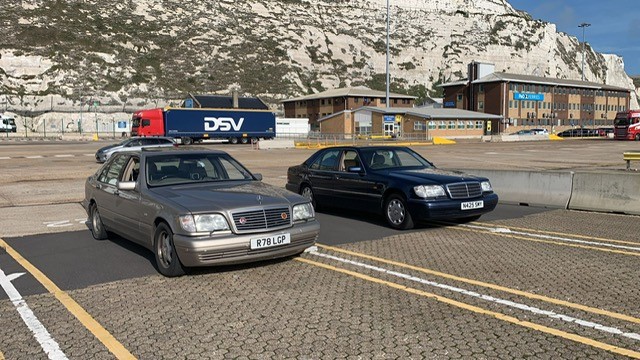
Being of a gentlemanly disposition, I assured Mr Mason that he would be waited for and not return across the ocean solo.
The next ferry arrived and departed at 20:00 hours. Almost immediately after boarding talking to one of the staff aboard, I discovered that there was no boat for the 16:00 ferry and everyone had been forced to wait. All the fretting and burning miles as well as extra petrol had been for nothing. Absolutely no notification from the Ferry company as to the delay.
PL-R S 320 Av. 25.5 MPG (keep in mind 100-130 KPH speed limits, Paul Mason on the leg Boblingen to Luxemburg achieved 16.1 mpg. On the leg Luxemburg to Dover was 22.5 mpg and Dover to Northallerton 23.95 mpg
Throughout the whole of this trip both cars drove faultlessly and with great comfort. Even after an 8 hour stretch on the last day one was able to get out of the driving position and not have any stiffness or feeling sore. That is why we own W 140’s.